
平安365
一线记者讲故事 | 明明是赔本买卖,这些小店为何甘愿坚持?_我的网站

A |
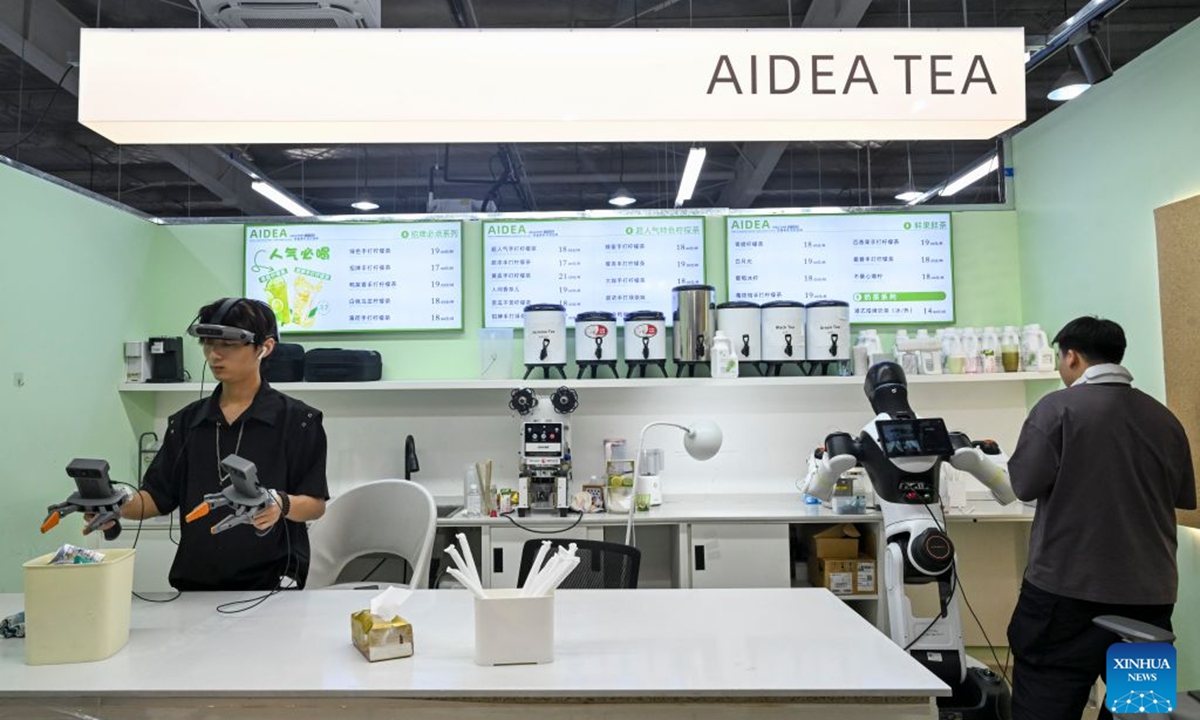
Nation's value added in the service sector grew 5.2 percent year-on-year, 0.5 percentage points faster than overall economic growth. Retail sales of services rose 5.3 percent year-on-year. In the first half of the year, the service sector expanded steadily, playing an important role in supporting industrial upgrading and meeting people's livelihood needs.
A meeting of the Political Bureau of the Communist Party of China (CPC) Central Committee held on July 30 called for effectively expanding domestic demand and optimizing supply.
From April 7 to 8, a national conference on the service sector was held in Beijing — the first national gathering in the new era devoted to the service sector.
General Secretary Xi Jinping called for advancing producer services toward greater specialization and the higher end of the value chain, fostering high-quality, diverse and accessible consumer services, and building more "China Services" brands, as well as striving to break new ground in the high-quality development of China's service sector.
Beijing convened a municipal service sector conference and pledged to actively shape the "Beijing Services" brand.
Shanghai released its 15th Five-Year Plan (2026-30) for service sector development, aiming to comprehensively enhance the global reach and international competitiveness of "Shanghai Services."
Southwest China's Chongqing Municipality set out to build a modern service industry system and burnish "golden calling cards" of service development such as "Chongqing Trade Global."
Since the national conference, regions and departments have coordinated their planning and accelerated the building of service brands. By 2030, China's service sector is expected to top 100 trillion yuan ($14.6 trillion) in total scale, with higher quality, a better structure and improved standards.
With that target in sight, the Chinese economy is undergoing a fresh "system upgrade."
I
Building more "China Services" brands is an inevitable choice that follows the laws of economic development and drives economic transformation and upgrading.
China's service sector has steadily expanded in scale and continuously improved in quality and efficiency since the 18th National Congress of the CPC, playing an important role in supporting industrial upgrading, meeting people's livelihood needs and driving job growth, according to Xi.
Scale is the most direct yardstick. In the first half of this year, the service sector accounted for 59.5 percent of GDP, making it the largest sector of the national economy, and contributed 66.1 percent to economic growth, emerging as the main engine of expansion. The figures reflect the sector's weight in high-quality development and in Chinese modernization as a whole.
The Chinese economy sits at a critical window as it shifts from factor-driven to innovation-driven growth, and from investment-led to consumption-led expansion. Projections show that during the 15th Five-Year Plan period, the service sector's contribution to GDP growth will rise steadily, making it the economy's main engine in every sense.
This is also where the key lies in answering people's expectations for a better life and in expanding domestic demand.
The changing Engel coefficient traces the leap in household consumption. At the start of reform and opening-up, the Engel coefficient for Chinese households exceeded 60 percent; in 2025 it stood at just 29.3 percent. The sharp drop in the share of spending on food has freed up vast room for consumption of services such as education, health, culture and tourism.
Global experience shows that once a country's per capita GDP passes $10,000, its consumption structure typically shifts markedly, with services taking a rapidly rising share. China is now in that critical transition. Consumption is moving from "subsistence consumption," geared mainly to basic needs, toward "development-oriented consumption" that seeks quality, experience and self-fulfilment.
From the breakout popularity of the Jiangsu Football City League and the Village Super League to the growing craze for "traveling to catch a show"; from the rapid spread of service points for the elderly and young children to 30-minute delivery of just about anything becoming the norm — service consumption is no longer an optional garnish but a necessity of a better life. With a middle-income group of more than 400 million, China is entering a golden period for expanding the capacity and quality of its service sector.
It is also a key step toward raising total factor productivity and developing new quality productive forces.
Take a garment company. In R&D, AI-assisted design can shorten development cycles. In production, intelligent transformation and digital upgrading can sharply lift efficiency. In distribution, modern logistics can cut overall costs. In sales, market analytics can match products precisely to customer segments.
Globally, as industries divide labor more deeply and integrate faster, leading manufacturers are broadly shifting toward service-oriented manufacturing, drawing on strengths in information, finance, R&D and design to dominate the construction of global value chains. Producer services play an increasingly prominent role in production networks, and largely determine whether product value can extend toward both ends of the "smile curve."
As the world's largest manufacturing nation, China still sees producer services account for less than 35 percent of GDP in value added, leaving gaps in scale, quality and efficiency compared with advanced international levels. Upgrading the service sector is key to moving from a manufacturer of quantity to one of quality.
II
In building more "China Services" brands, tailoring measures to local conditions and applying targeted policies is the basic methodology.
Underscoring demand-driven development, reform breakthroughs, technology empowerment as well as opening-up and cooperation, Xi called for carrying out capacity-expanding and quality-upgrading initiatives in the service sector.
The service sector spans many categories and takes many forms; its subsectors differ in their levels of development and the challenges they face.
Start with producer services, these must serve enterprises across the full span of production and operations, with the aim of firmly supporting industrial transformation and upgrading by shoring up weak links along the entire chain.
Among these, the deep integration of advanced manufacturing and modern services — the so-called integration of the two sectors — is one of the core propositions of current industrial policy. For a long time, manufacturing and services have operated on parallel tracks, belonging to different policy systems, statistical classifications and regulatory frameworks.
Breaking down this divide requires embedding services into every pore of manufacturing, and the breakthrough lies in data and policy. On one hand, the industrial internet should serve as the link that connects data silos, drawing service firms to develop specialized, manufacturing-oriented services on a data foundation and forming an ecosystem of "data flow — embedded services — value creation." On the other, statistical and policy systems need reform: drawing on international experience, service units inside manufacturers should be able to keep separate accounts and enjoy service-sector policy benefits, giving the integration of the two sectors a clear policy foothold.
Turn to consumer services. At their core, these address people's needs across the full life cycle, with the aim of better meeting aspirations for a better life by raising the development level of key consumer service areas.
Take elderly care and childcare. Demand is moving up from basic provision toward inclusive and even mid- to high-end services, and it is broadening: expectations now span facilities, services, and material and emotional needs alike. Supply-side structural strains are equally acute. In some big cities, beds at high-quality elderly care institutions are nearly impossible to secure, while many beds sit empty at township homes for the elderly. Places at standardized chain childcare centers are hard to come by, even as some small childcare providers struggle to stay in business.
Faced with strains that are multilayered and varied, only precise disaggregation and tiered policies can deliver genuine quality upgrades.
At the baseline, the government should take the lead in improving the three-tier elderly care network across counties, townships and villages, reinforcing the social safety net. At the middle tier, the government should guide the way — using investment, tax and fee incentives, resource guarantees and institutional reform to mobilize more social forces, so that more families can access elderly care and childcare that is affordable, reliable in quality and safe. At the upper tier, industrial policy and a better business environment should support market players in providing personalized and customized services.
III
Building more "China Services" brands means seizing the initiative through the newness of innovation and winning reputation through the substance of quality.
Building more "China Services" brands requires deepening institutional opening-up.
Brands are forged only in open competition. However, barriers in goods trade sit mainly "at the border" — tariffs and customs clearance — while barriers in services trade are more often hidden "behind the border," in market access rules, regulatory systems, qualification recognition and the mutual recognition of professional credentials.
China needs to keep refining the negative list for the service sector and further trim its scope, so that it becomes a genuinely predictable and workable opening-up commitment. It also needs to improve regulatory transparency and consistency, align regulatory rules with prevailing international practice, and reduce hidden barriers. At the same time, cross-border mutual recognition of professional credentials for engineers, physicians and others should be actively advanced, allowing high-end service talent to move freely.
Building more "China Services" brands also means that, as the saying goes, it takes a good blacksmith to forge good iron.
A recent piece of news drew global attention: Mixue Ice Cream & Tea has grown to nearly 60,000 stores worldwide, becoming a food and beverage chain of broad global influence.
Behind Mixue's success lies an intelligent supply chain system. At the front end, it converts consumption data into planting data, guiding farmers to produce to order. In the middle, an intelligent scheduling system coordinates nearly 30 warehouses nationwide, with cold chain coverage reaching more than 97 percent of stores. At the tail end, algorithms provide precise support for choosing store locations. Foreign media have remarked that the chain store's mascot "Snow King" will turn up in your city sooner or later.
Differentiated competition among service brands, in the end, comes down to a contest of innovation capability. For "China Services" brands to truly stand firm, make a name and travel far, they must seize the initiative through the newness of innovation, pushing continuous breakthroughs in service models, technologies and consumption scenarios, and win reputation through the substance of quality.
From selling products to selling services, from "Made in China" to "China Services" — as a 100-trillion-yuan service landscape slowly unfolds, there is reason to believe that these gleaming "China Services" calling cards will converge into powerful momentum for the high-quality development of the Chinese economy.
This was compiled from an article originally published on the front page of the People's Daily on August 13, 2026.
。 在石家庄,有三家不起眼的小店,坚持着一件让人看不懂的事——免费请陌生人吃饭,进门管饱,无限续餐。有人说他们作秀,有人说他们另有所图。质疑声不断,可他们也没停,一请就是好几年。一家不限量的爱心素食面馆石家庄市新华区一家不起眼的小店,店内没有醒目的价目展板,只简单标注素面十元一碗,管饱不限量。店内小黑板写着:残疾人免费,65岁以上老人、环卫工人半价。墙上还不定时张贴“今日免费”,半价和免费餐同样不限量。袁英莲做这件事,已近七年。

B | 说起免费缘由,面馆老板袁英莲解释,当年给父亲端一碗面,还没端到桌上,父亲倒地,再也没起来。开这家店,是为了弥补父亲没吃上最后一碗面的遗憾。而提供免费餐,是因为自己曾受过太多帮助,如今想把这份温暖再传递给更多有需要的人。面馆常年亏损,袁英莲靠自己的刺绣生意往里贴钱,每月最多贴六七千元。

C | 但善意也包围着她:有人无偿送木耳,有人常年捐陈醋,常来的食客把自家种的菜往店里送。店里帮忙的多是义工,有个小伙子每天凌晨3点半起床擀面,坚持了许久,就为“让这家店开得久一点”。一家“如遇困难,免费吃面”的小馆“如果你在石家庄遇到困难,来小店说‘来一份腌肉面’,吃完直接走,不必客气。”庄北灵寿腌肉面馆墙上,这张海报挂了近7年。老板高志江“因为自己淋过雨,也想为别人撑把伞”。最困难时,他手里只剩两块五,要熬三天。2014年开店,2019年启动“免费吃面”。

D | 有人问怕不怕恶意蹭饭?他坦然道:“但行好事,莫问前程。一碗面没什么大不了的。”如今,4家直营店、4家加盟店、17家学员店都在做“免费吃面”的公益活动。一家送出28万份早餐的早餐店每天凌晨四点,石家庄市长安区众爱餐厅灯火通明。志愿者削土豆、熬米粥,红色马甲穿梭在热气中。这家公益餐厅从2021年6月开始,专为环卫工人、快递小哥、独居老人提供免费早餐,全年无休。

E | 五年来,餐厅从1家发展到2家,累计送出超过28万份免费早餐。发起人贾军亮说:“只要有需要,推门进来就能吃顿热饭。”坚持靠的是“众爱”——参与志愿服务的人数从最初的10人增长到9000余人。环卫工人吃完早餐,常自发拿起扫帚帮忙收拾。发起人吕晓燕感慨:“爱从来都是双向奔赴的,我们温暖了他们,他们也温暖着我们。”这三家店的故事都不惊天动地,却让人与人之间的暖意被更多人看见。袁英莲用十年念想守一家小店,高志江把曾经经历的苦化作“说一声就能免费吃”的承诺;众爱餐厅用五年多的坚持,送出着“有人惦记”的温暖。

F | 他们为什么坚持?答案很简单:不是作秀,是心疼;不是另有所图,是见不得别人“受伤”。没有豪言壮语,只有日复一日、年复一年。而这样的故事不只发生在石家庄。

G | 北京、天津、上海、成都、银川……越来越多的餐馆加入了“爱心餐”的行列。从乡村的爱心食堂,到街角的免费早餐铺,善意从来不是一座城市的独白,而是一场没有终点的接力。

H | 一份免费餐或许微不足道,但足以让一个疲惫的人相信,这人间值得。总监制:王丽平策 划:张 霰 耿 佳文 案:耿 佳 许艳艳拍 摄:姚 杰 郭晶璇 康紫祎 宋霈雯制 作:郭晶璇。
Current article:http://l92lov.shuosongzoutunchutao.cfd/v2ogjy/20260826/45265.html
Published on:07:53:03


平安365TXT下载声明:
1 我的网站免费提供的平安365,均由网友上传,供下载测试之用,不作商业用途,下载后请二十四小时后删除!
2 我们根据txt小说全文所整理出平安365txt电子书全集免费下载,由程序自动生成平安365txt下载文件。
3 书友所发表的txt小说平安365的相关评论,并不代表本站赞同平安365txt下载或者支持平安365的读者观点。
4 如果发现小说《平安365txt全集》无法下载未及时更新请联系我们。如果您喜欢平安365txt电子书,请支持作者到书店购买正版图书。感谢您的合作与支持。
5 好看的小说平安365是作者"百年不渡"的最新力作,平安365电子书由网友发布;小说平安365版权属于作者所有,如果侵犯您的利益,请通知我们。